"Tuscan Hops?"
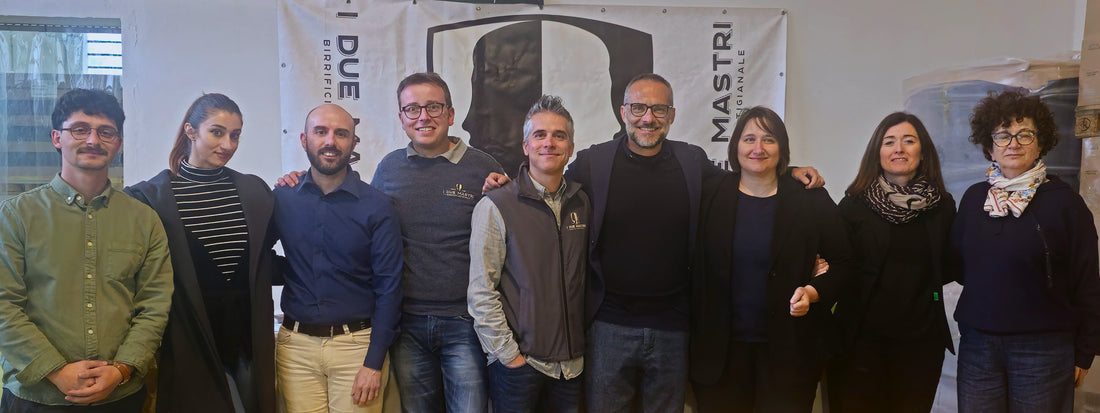
This was the question posed by Birrificio I Due Mastri during the meeting held on April 18th at their production facility in Montemurlo (Prato).
The topic of hop cultivation in Tuscany is very important to Birrificio I Due Mastri, which has always championed local raw materials. After participating in the production of Prato barley malt, the brewery committed to organizing a discussion table with the aim of also advancing the project of a local hop farm.
The presentation by Stefano Fancelli, president of the Luppolo Made in Italy business network in Città di Castello, clarified that hop production in Tuscany is feasible. Drawing on his network's experience in the neighboring Umbria region, he emphasized how a range of Italian hops represents an absolute novelty in the global market: hops capable of significantly enriching the quality of Made in Italy brewing products and ensuring substantial profitability for agricultural businesses.
Agricultural businesses did not fail to participate in the meeting, expressing their interest in being part of an operational development following this initial discussion. Even very young businesses, such as Tra Bosco e Stelle from the Reno Valley in Pistoia, see hop cultivation as an opportunity for entrepreneurial growth and diversification that, to date, has not yet been exploited by other companies engaged in more traditional agriculture.
Matilde Di Stefano, owner of the Tra Bosco e Stelle Farm, has made herself available to support the innovative project of cultivating an experimental hop field in the Prato area, within the lands of the Datini Agricultural Technical Institute.
The school principal, Prof. Francesca Zannoni, expressed her strong
motivation to start this experimental hop field project, thus opening doors to new growth opportunities for the institute's students, in order to offer them a clear diversification in their educational offerings.
The presence of a partner like the Datini Institute, as an educational and training figure, is fundamental for the correct development of the project, as reiterated by Dr. Leonardo Borsacchi, coordinator of the ARCO Laboratory of the Prato University Pole, who sees hop cultivation as an opportunity for territorial development with significant implications for the social economy and environmental impact.
The creation of a hop field in the Prato area is therefore imminent, and the synergy born between the various actors as producers, processors, and trainers could mark a momentous transition for the local agricultural economy.
Last but not least, the contribution of the Councillor for Economic Development of the Municipality of Prato, Benedetta Squittieri, must be mentioned, who has always followed the development of the various phases of the project with great enthusiasm and support. The Municipality, together with the Province of Prato, with the participation of President Simone Calamai, gave their approval for the creation of the experimental hop field on the grounds of the Datini Institute and also assured the involvement of an adjacent plot for a second phase of expansion.